
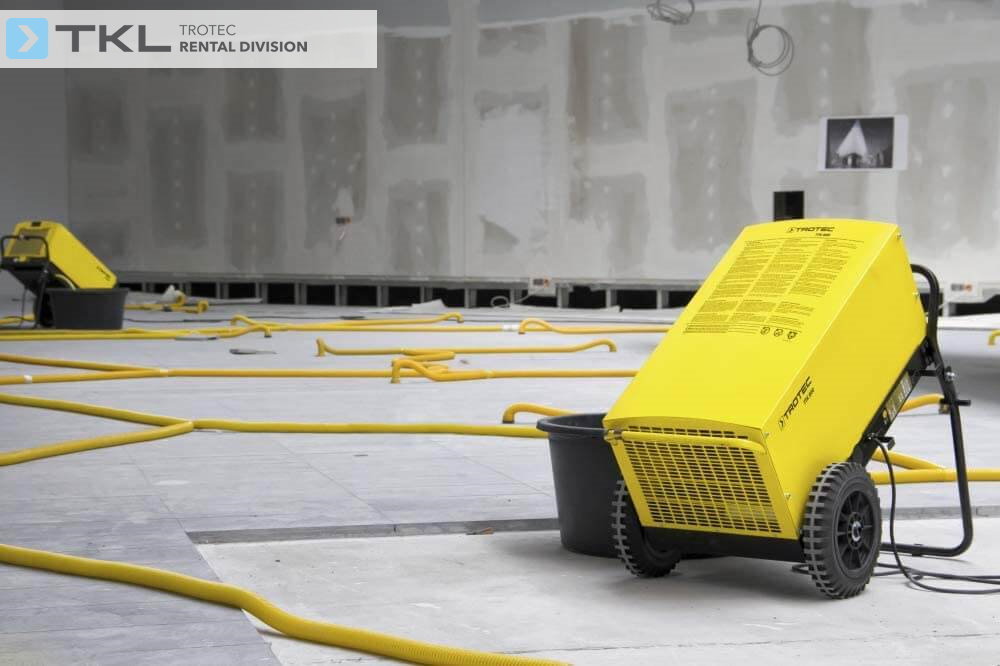
A newly completed building holds tons of water within it. Concrete, plaster, screed and brick are mixed with water during production; a large portion of this water continues to remain in the structure even after construction is finished. In an average-sized apartment, the amount of water carried by building materials can easily reach several thousand liters. When left to evaporate naturally, drawing out this water can take months depending on the season.
Construction drying turns this process into a measurable engineering task instead of leaving it to chance. As TeknoDRY, we go on site, measure the volume of the structure and the moisture content of the materials, calculate the required drying capacity, and position the appropriate combination of units.
Why does waiting become costly?
Every finishing job carried out before the structure has dried sufficiently carries the risk one level higher. Parquet laid over damp screed swells, walls painted too early develop blisters and stains, adhesives fail to hold, and tiles eventually shift out of place. Removing and redoing this work costs multiple times the original cost in both materials and labor. Moreover, the delivery date slips and penalty clauses come into effect.
The second benefit of drying is that it eliminates mold risk from the outset. In a closed and damp structure, mold spores settle within a few days; mold that has gotten under the plaster comes back for years through its smell and health effects.
How do we work on site?
- Measurement and survey: The volume of the structure, material moisture, ambient temperature, and relative humidity are recorded; the amount of water to be dried is calculated.
- Plan: The number of units, their positions, and air circulation direction are determined according to the floor plan. Sectioning is carried out if needed.
- Installation: Dehumidifiers, air circulators, and heaters if required are put into operation; the electrical load is planned.
- Monitoring: Ambient values are measured regularly, and progress is recorded. Units are withdrawn from sections that reach the target moisture level.
- Delivery report: Initial and final values, duration, and the amount of water collected are presented in writing.
Which units are used?
In environments where the temperature is above 15 °C, condensation dehumidifiers are the most economical solution; the TTK series is designed for this purpose. On winter construction sites or in unheated basements and parking garages, when the temperature drops, condensation efficiency decreases — at this point, the desiccant (rotor) TTR series comes into play, continuing to operate even at low temperatures. Air circulators are used together with electric or diesel heaters to speed up surface drying and bring the ambient temperature to the target level.
How long does it take?
The duration depends on the volume of the structure, material thickness, outdoor conditions, and the targeted moisture value. Under normal conditions, rough drying of an apartment is completed within a few days, while bringing thick layers such as screed down to the target value takes between two to four weeks. It should be noted that when left to dry naturally, the same job takes three to six months depending on the season.